Thinking → Writing → What?


Why might writing be the most daunting task? It is supposed to be just about expressing a thought, right? There is something almost comically simple about the proposition. You think of something, you write it. Perhaps you polish it afterwards, perhaps someone else reads it, perhaps, in the best case, they understand what you were trying to say. But this little story of writing feels more and more unconvincing the longer time I spend with it. Writing rarely feels like the externalisation of something that was already sitting inside, patiently waiting for a body. More often it feels like the point at which whatever I thought I was thinking begins to behave differently. And maybe that is why there is something shameful about it, although not shameful in the familiar sense of having written something foolish or incoherent. It is a stranger shame, perhaps the embarrassment of having watched something become visible without ever quite knowing what it was before it became visible.
Actually, I don't think writing is difficult because it reveals too much. At least that is not how it feels to me. It is difficult because of the pause. That tiny space between writing and thinking that we somehow never talk about, as though it were not really there. We are very comfortable with that sequence or almost the formula ‘thinking → writing → thinking’. It looks sensible. It looks like a process. Thought becomes writing, writing returns us to thought, and then thought produces more writing. We use the arrow almost innocently, as if it were simply a piece of punctuation for movement. But I have begun to wonder whether almost everything that matters happens inside that arrow, precisely because we have stopped seeing it.
Thinking itself, at least the kind of thinking I recognise in myself, is not particularly orderly. Images, memories, words, sounds, faces, half-formed arguments, some absurd thing someone said five years ago, a sentence from a book that seemed unimportant at the time and suddenly comes back while brushing your teeth. Some of these things disappear, some refuse to disappear, some acquire significance simply because they keep returning. All of this gets gathered under the rather impressive name of “thinking,” though I am not sure what exactly is being granted by that name other than permission for the mess to continue. And when the mess becomes too much, when thoughts begin stepping over each other and sleep becomes impossible, one gives up and writes. You take the thing that has been circling and bleed it into the empty gutters of two ruled lines on a piece of paper. For a moment there is relief because the page appears to receive it. The words even seem, briefly, to march to the tune of whatever assemblage you had been calling thought.
Then the paper does something back.
This is the part that interests me. The paper is not an innocent surface. The pen is not an innocent instrument. The moment the thought becomes a written figure, it acquires a stubbornness it did not have before. A word has to be chosen. A sentence has to continue. One cannot simply leave the thought hanging in the ambiguous, half-lit condition in which it existed a second ago. The written word sits there looking at you. You can reread it. You can disagree with it. You can become embarrassed by it. You can discover that the sentence you have just written was not what you meant, except that it now becomes difficult to remember exactly what you meant before writing it. So you alter one word and the altered word changes the sentence and suddenly the sentence has changed the thought. This is where the whole metaphor of a thought “brewing” or “simmering” before writing begins to seem strange. Brewing makes it sound as though thought is a passive flame, receiving ingredients, quietly becoming richer until it reaches the proper consistency and can be poured into language. But perhaps thinking is not something that happens first and writing second. Perhaps thinking is partly what happens when writing begins to interfere with it.
Maybe this is why writing feels like a spell. Not because writing reveals some hidden truth, but because the act itself can acquire its own momentum. One begins writing to catch up with a thought and then, sometime later, finds oneself far away from the thought that started the whole business. The hand has continued, the sentences have accumulated, and the original thought has become difficult to locate. There is something almost funny about this because we continue to say that we “put thoughts into words,” as if thoughts were objects that could be lifted carefully from one container and placed into another. But perhaps words are less like containers and more like events. You do something with a word; someone else does something with it; the situation changes and the word changes with it. Even the same word can become affectionate, technical, ridiculous, insulting, sacred, meaningless, depending on what is happening around it. We know this in ordinary life without needing a philosophy of language. Say a word ten times and suddenly it sounds absurd. Put it into a different sentence and it becomes almost a different word. Maybe this is part of what writing does so violently, it slows language down enough that we can see it happening. The word, which seemed transparent a moment ago, becomes oddly material. You can look at it. You can turn it over. You can hear its stupidity. You can hear its history. You can notice that meaning was never quite sitting inside it waiting to be extracted.
Perhaps this is also why I find the word “spelling” so irresistible. To spell a word is simply to arrange its letters correctly, but spelling has also always had this faint association with enchantment, with being under the influence of something. And there is something rather beautiful in that accident. Maybe when we spell a word, the word also begins to spell us. We think we are giving the word its place in the sentence, while the sentence is quietly rearranging the thought that made us choose the word. I write because I think of something, but then what I have written becomes one of the things I now have to think about. So perhaps the arrow between thinking and writing is not transporting anything. Perhaps it is modifying whatever passes through it.
And this makes the question of where the whole process began rather embarrassing. Did I think first? Perhaps. But what made me think that? Something I read? Something somebody said? A memory? An image? Something I forgot I had read? Then perhaps writing was already there before this particular thought arrived. And if I keep moving backwards I eventually end up with a chain in which there is no satisfying first term: thinking → writing → thinking → writing → thinking → writing. We take one fragment out of this endless movement and call it “my thought” and another fragment “my writing,” but the little arrow in between keeps exposing the awkwardness of those names. There is never quite a clean transition. The old thing does not disappear when the new thing arrives, but neither does it remain untouched. Something survives as a remainder, a pressure, a faint distortion. The sentence we finally keep contains traces of the sentences we did not keep, though not in a way that allows us to retrieve them as evidence. The erased word is gone and yet it has something to do with the word that replaced it. The hesitation disappears and yet the sentence bears the mark of having hesitated. There is a peculiar kind of presence in what is no longer there.
I think this is one reason writing can feel so uncanny. The page gives us the illusion of arrival while quietly recording the impossibility of arrival. We look at the final sentence and imagine that it is the thought, but the sentence is actually the residue of many other possibilities that have been discarded. A writing surface is full of ghosts that do not need to be visible in order to have participated in what remains. And perhaps this is what we mean when we say something “doesn't quite sound right.” It is not always that the meaning is incorrect. Sometimes the sentence has the wrong history behind it. Some other sentence, some other word, some other rhythm seems to be lingering just outside it.
This is why I keep returning to the arrow. What exactly is this thing doing between thinking and writing? It is tempting to make it another object, another concept, some hidden mechanism that explains the relation. But that feels too easy. It would be like saying, well, thinking and writing are two things and the arrow is the third thing between them. And then we would have to explain the third thing, and eventually we would have another arrow between the arrow and something else, and we would have simply moved the problem one step away. The arrow is not outside the relation. It is part of the relation. It is even visibly written. It belongs to the same world of marks that it seems to be describing.
So maybe the useful question is not what the arrow is but what it does. It directs. It suggests sequence, consequence, movement, transformation. But it does not actually perform the movement it indicates. It asks us to move. It is strangely empty in that sense. It contains direction without containing destination. And perhaps that is why it works so well for thinking and writing. The movement is real, but neither thinking nor writing possesses it. They emerge in it, perhaps even because of it. I begin with something I call a thought, but I only find out what that thought can become by putting it somewhere it can meet resistance. Writing provides that resistance. Then the writing becomes resistant to itself. I read it back and discover another possibility inside it. That possibility becomes the next thought. What looks like a progression is therefore also a series of small transformations, each one leaving the previous state slightly altered.
This is where I think the whole thing becomes more interesting than a simple argument about writing. Maybe the “thing” that we call a thinker does not exist entirely before these movements. Maybe neither does the thing we call a writer. There is a tendency to imagine the individual as already formed and then imagine relations as things that happen between individuals. I am here, you are there, and then we interact. But writing makes this arrangement look slightly suspicious. The person who began writing is not quite the person who finishes writing, not because they have discovered some authentic inner self, but because the activity itself has changed what can be thought next. The page becomes part of the thinking. The sentence becomes part of the thinker. The thought changes because it has encountered something outside itself, but that “outside” has now become part of the conditions of its becoming. Perhaps this is what makes the movement so difficult to isolate. We want to say that thinking produces writing and writing produces thinking, but perhaps neither one is fully there before the movement begins.
And then, because the mind is incapable of leaving anything alone, I start wondering about the shape itself. Why does the arrow look like an arrow? Because that is what we have decided an arrow looks like, obviously. But that obviousness is strangely revealing. Its meaning is not stored in the shape the way a secret is stored in a box. We have learned to make it do something. Point here. Go there. This becomes that. Read the next thing. Follow this relation. It is a little language of its own, except that we rarely notice it as language because it has become so useful. Perhaps the arrow's meaning comes precisely from its use, from the little jobs we continually ask it to perform. And then thinking and writing begin to look less like two substances and more like things we do, things that take shape within practices, habits, situations, repetitions. Which perhaps explains why the same mark can mean one thing in mathematics, another in a film script, another in a family tree, another in a badly drawn set of directions. The mark survives, but what it does changes.
What interests me most, though, is that the arrow also leaves space behind it. Not empty space exactly. A space in which something can be added, repeated, delayed. This is easy to miss because we think of an arrow as pushing forward, but perhaps its real power lies in making room for whatever comes next. Thinking → writing does not close anything. It opens another point at which writing can become thinking again. There is continuity, yes, but there is also accumulation and exchange. Something slows down. Something gets lost. Something returns. Something that looked meaningless suddenly becomes useful three pages later. A discarded phrase reappears in another sentence and acquires a different life. The movement grows not because it is moving efficiently towards an end, but because every stage leaves something behind for the next stage to pick up.
Maybe that is why writing can feel both exhausting and strangely abundant. It does not simply consume thought, it produces more material for thought to consume. You write to empty yourself and instead discover that you have made more things to think about. You thought writing would reduce the clutter and instead it reorganises the clutter into a different kind of abundance. The page does not save you from the mess. It gives the mess somewhere to happen.
And perhaps this is why I hesitate to call writing an expression. Expression still sounds too much like release: something is inside, something comes out, the transaction is complete. But maybe writing is closer to a relay. Not because something is handed intact from one person to another, or from thought to page, but because each form leaves something for the next form to work with. The thought does not survive writing by remaining unchanged. It survives by becoming something else. The writing does not preserve the thought; it prolongs its ability to generate another thought.
Which brings me, again, to the arrow.
Maybe I have been treating it as though it were a little line with a point at one end, when perhaps it is better understood as a density. A collection of tiny moments that, when viewed from far enough away, becomes a line. One point, another point, another. Up close, it is all interruption: a correction here, an abandoned word there, a sentence that took a wrong turn, a memory that arrived too late, an idea that seemed ridiculous until three paragraphs later. But from a distance it looks smooth. We call that smoothness coherence. We call it an argument. We call it writing. Maybe the line was never really smooth. Maybe it only looks smooth because we are looking at the accumulation from too far away.
And perhaps that is what writing asks us to do, zoom in and out constantly between the point and the line, between the particular sentence and whatever larger continuity we imagine it belongs to. To write is to place one little mark after another without ever being certain what image they will make from a distance. Sometimes it becomes an argument. Sometimes it becomes a mess. Sometimes, if you are lucky, it becomes something neither of those things quite captures.
So perhaps writing is daunting not because it asks us to say what we think, but because it quietly unsettles the idea that there is a stable “what we think” waiting to be said. The act of writing introduces friction, and that friction alters the thing we thought we were transferring. Some meanings survive. Some disappear. Some return in another form. Some never return but leave enough of an impression on the surviving sentence that we know something once occupied the place they now leave empty. The writing becomes a record not only of what was said but of everything that had to be moved aside for it to be said. Maybe the arrow, then, is not a passage between thinking and writing. Maybe it is the condition under which neither one remains finished. Maybe it is the little space where a thought can lose itself and become another thought. Maybe it is the reason writing never quite arrives anywhere. And perhaps that is not its failure. Perhaps that is the whole point. Because if the arrow were ever to stop, if thinking finally became writing and writing finally became thinking, then there would be nothing left to write.
So it keeps going.
→
And perhaps what we call a line is simply what that movement looks like when we stand far enough away from it.
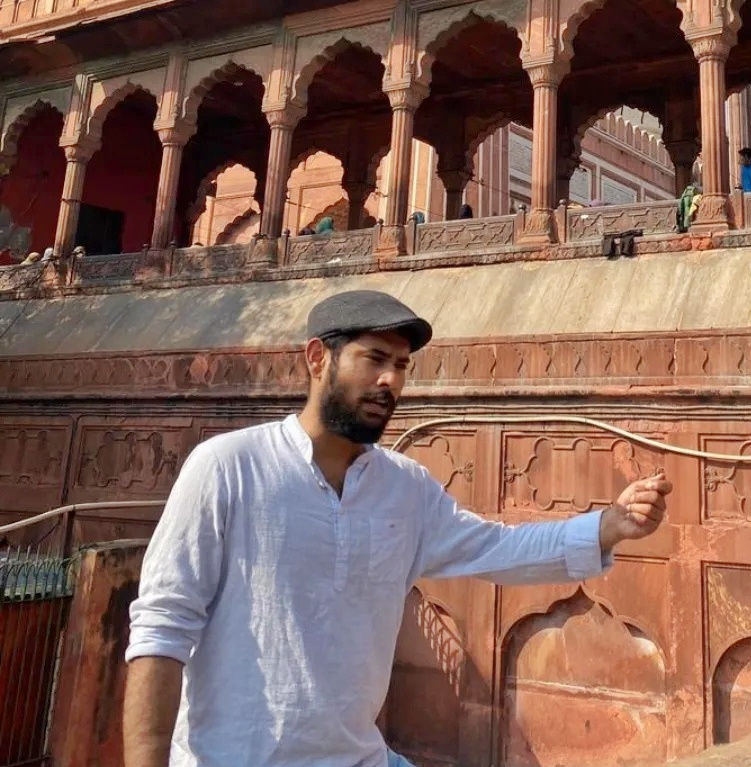
I am Vedant, a PhD candidate in Social Anthropology, quietly preoccupied with methods, though I am not always sure I would call it a preoccupation in the conventional academic sense. I am interested in what happens when ethnographic work slips out of the usual forms of writing and begins to wander through films, images, exhibitions, conversations, installations, fragments and other slightly unruly ways of knowing. My own research looks at milk, its movements and the worlds that gather around it in northern India, though this piece is not really about milk. It is about something more ordinary and, perhaps for that reason, more difficult, the strange interval between thinking and writing. Alongside my doctoral work, I am a co-editor of Khôra, an experimental online space for bringing together anthropology, art, fieldwork, writing and other ways of making sense of the world. I suppose I am interested in all the things that happen in the gaps between these forms—and what those gaps might make possible.


Such a beautiful reflection on such an indeterminate, inexplicable, and fleeting experience of the so-called "writing process". It is precisely this perpetual non-correspondence between thinking and writing, captured by the more-than-metaphorical arrow in your piece, that stands out in your attempt to capture, understand, explicate, and name the anxiety that structures and saturates every attempt to put words on paper. The piece does so much in delineating what one might call the affective structure of writing as a personal, practical, and intellectual struggle.