"Ahmedabad – A Deeply Misunderstood City" Usama Nalakath and Safwan Amir

Updated: Feb 19

An Ahmedabadi Setting – a meeting of biases
While exploring the extended site of the majestic 15th C Sarkhej Roza in Ahmedabad, we came across a man in his thirties looking out for some conversation. His dressing style was urban, and on further inquiry, he revealed a majoritarian uppercaste Hindu name. He spoke with some level of caution, even though we tried to be polite and friendly. He was talking to us based on a larger bias that the mainstream had created for the ghetto that Juhapura, the space where Sarkhej Roza was located, had become over the past few decades. The ‘divided city,’ as Yagnik and Sheth (2011) have called it, has seen barriers emerging physically and mentally. It got us wondering if a location change would have eased our conversation. But, before assuming the worst in situations like this, there was another layer of biases that even we, as minorities, were well versed in – Ahmedabad is dangerous for Muslims. And, this came up almost any time a Malayali Muslim living in Ahmedabad would have a conversation with people back in Kerala. So here it was, bias one (Muslim localities in Ahmedabad are dangerous) meets bias two (Ahmedabad is a difficult city for Muslims to navigate) in the most ironic of spaces: Sarkhej Roza, a complex that housed the maqbara of the great Sufi saint Shaikh Ahmed Khattu Ganj Baksh (d. 1445)—a saint who preached love and symbolised the meeting of traditions.

The purpose of this short article is then two-fold: one, it aims to introduce Gujarat, especially Ahmedabad, to a non-Gujarati audience; second, it attempts to speak about the rich Muslim heritage that the city has to offer which saw value in engaging with other traditions rather than being insular. The article will talk through snippets of history rather than follow a clear-cut timeline. We are not building on any primary sources to do so, though students of history can find much to connect through Persian sources like the seventeenth and eighteenth-century Persian sources like the Mirat-i-Sikandari and Mirat-i-Ahmedi, and make use of the sixteenth-century Portuguese source, Decadas da Asia I-IV, for triangulation of facts. While these important documents tell us a lot about the city, living cultural artefacts in the form of mosques and dargahs also have much to offer.
A global location for centuries
Any talk on Ahmedabad usually speaks of its inherent nature in terms of attracting trade. To the extent that people in Ahmedabad seem obsessed with business and the market. This is partially due to how the city is located and its role in the larger Indian Ocean maritime trade. For centuries, it has been the perfect hub for players on both sides – the East and the West. The thirteenth to seventeenth centuries saw a massive flow of products like spice and silk through the coasts of Gujarat. Traders were directly in touch with African, Chinese, and Southeast Asian communities. The Gulf of Cambay (Khambat) would receive ships from different parts of the Indian Ocean, and the Sabarmati River ensured an easy inflow of goods into the city of Ahmedabad. It is this Ocean-River nexus that allows for this geographical location to flourish in many ways. This is similar to how the River Nile plays a crucial role in multiple North African cities by directly connecting it to the Mediterranean Sea.
Jains, Muslims, various Hindu caste groups, merchants, traders, farmers, agrarian labourers, and slaves are part of the social composition of this region that saw people from other parts of the world daily. Language was easy to communicate with people speaking more than one tongue. Translators were readily available, and they went about making life easier for everyone who shared this cast locality. However, to understand how Ahmedabad became an essential juncture of power, the city's inception as the capital of the Gujrat Sultanate needs to be considered.

The inception of the city of Ahmedabad
The best way to understand the inception of Ahmedabad is to follow the establishment of mosques in the city. This is partially true for almost all localities where Islam appeared across South and Southeast Asia. Mosques, as a material representation, were established to ensure that the ruler or preacher had done their duty in spreading the message of the Prophet. The immaterial aspects are the kinds of values that they enshrine along with the mosque into the souls and bodies of their followers. It is a combination of this that allows for a particular kind of subjectivity. It can be said that spiritual sovereignty is a crucial aspect of sovereignty and one’s subject formation in general, and the era in consideration definitely invested a lot into it. Thus mosques, in these Indian Ocean settings, act as artefacts that give us an idea of the ways in which Islam was translated onto new regions. A comparative example will be the Cheraman Mosque in South India. The mosque not only embodies a distinct South Indian flavour in terms of architecture but also becomes a symbol for the kind of interactions that traditions underwent back then.
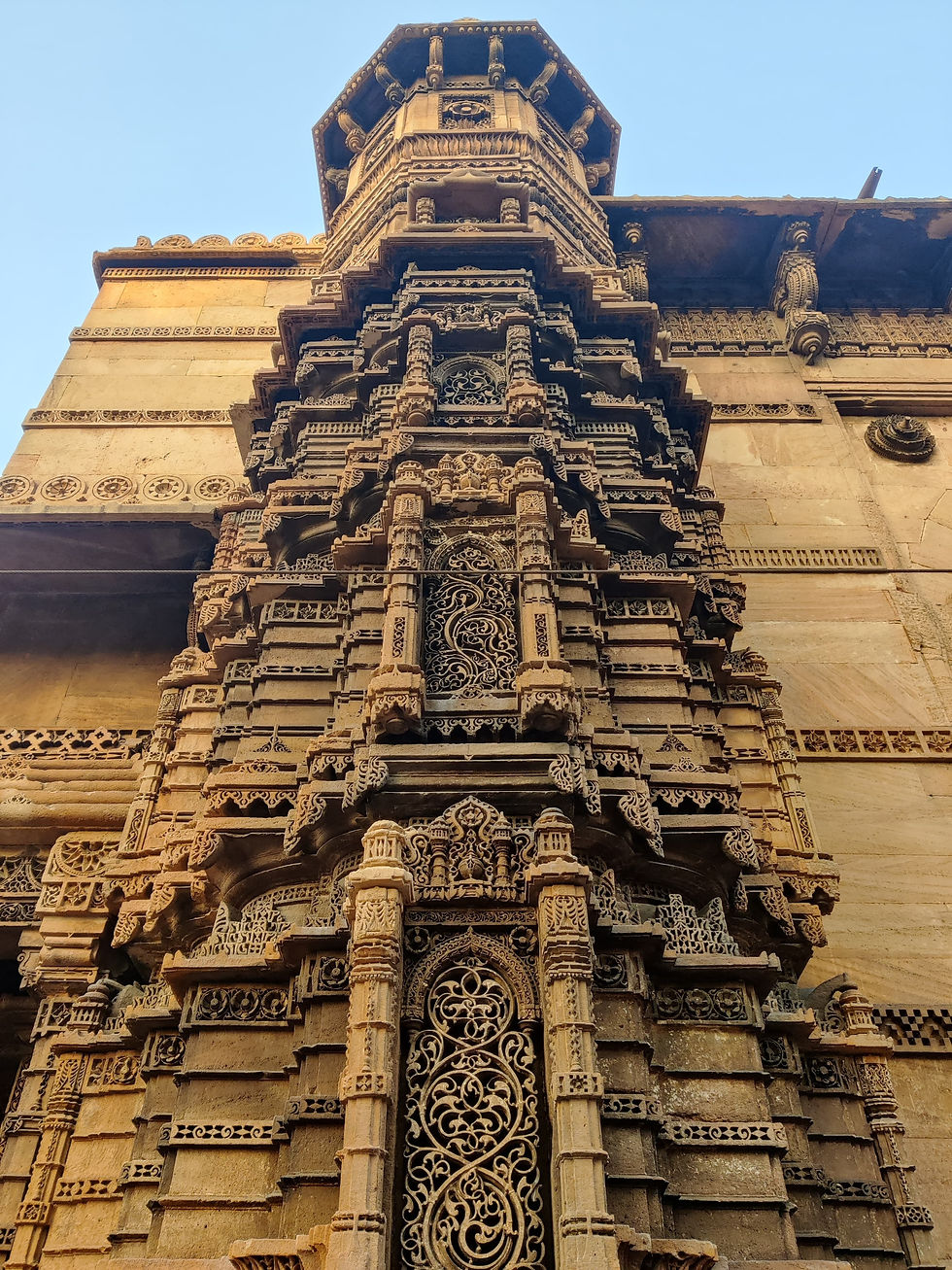
Similarly, the first noticeable aspect of the main two mosques of Ahmedabad – The Jama Masjid and Sarkhej Roza mosque – is their close association with the architectural styles of the Jain temples in the city. While it is now known as Indo-Saracenic, the huge influence and inspiration of Jain styles need to be thought through. To say that traditions were in conversation with one another is to recognise that Islam did not establish itself as a foreign faith but as one that recognised the existence of multiple traditions. Co-existence does not become a term that scholars of syncretism in the twentieth century would pick up, but a way in which people of varying traditions recognised the role each had to play in contributing to a society. More than a functionalist or reductionist approach, this article will delve into this concept further ahead while discussing naval powers.

To return to a discussion on the architecture itself, the Jama masjid was built by the founder ruler Ahmed Shah I (d. 1442). Huddled currently in the Old City’s bustling market, the structure is almost hidden from an outsider navigating through the crowded path. Once they do reach the gates and enter, the mosque brings about an immediate quietness that stands in stark contrast to the noisy world the outsider had just left. Almost playing on the duality of deen (faith) and dunya (world), the mosque and the market is a great way to understand early Muslim life in Ahmedabad. The architecture of the mosque disallows sound to travel in, giving the faithful much-needed respite from a long day of haggling or selling products. It also reminds the believer that the world is not the ultimate and that there is much more to be experienced in the afterworld. It is possible that this kind of intervention into the lives of Gujaratis (prior to Islam) might have given them an alternative approach to wealth where they could now partake in it without trying to find ways to distance themselves from it through superficial means. Wealth could now also be read as a blessing and a reason to spend more on charitable causes.
In light of such spending, one needs to talk of Sarkhej Roza. It was on the suggestion of the saint Ahmed Khattu that the founder ruler Ahmed Shah moved his capital to the city of Ahmedabad. The resting grounds for the saint were built on Ahmed Shah’s orders to echo the love and reverence he had for the saint. This tells us how the city is indebted to both these Ahmeds, and it is precisely due to their strong bond that people are still left guessing to this day whose name is the city named after. Both complexes developed over time. In the Old City, spaces started emerging based on the resting grounds of rulers and their families. Mahmud Begada, grandson to Ahmed Shah, would expand the Sarkhej Roza and built a palatial complex around the area. Observing the beauty of the complex, the Swiss-French architect and designer had the following to say about Sarkhej in the 1950s: “Why do you need to visit the Acropolis in Athens when you have this here?”

Mahmud Begada is an important figure in the history of Gujarat because it is under his leadership that the society was organised. It is his revenue system and roles provided to varying classes of people that was followed by the Mughals, who went on to take over Gujarat from late sixteenth century onwards. One of the important points to notice is that Mahmud Begada brought about class distinctions so that governance could be bettered. This was not to say that social classes were then bound by familial legacies – something that would be enshrined in the way in which the colonisers would classify people in successive centuries. Rather, even slaves from distant regions could climb the social ladder and become part of the nobility. It was a system that allowed for merit not on the basis of lineage but on the basis of one’s accomplishments.
The first Indian Ocean Camaraderie?
When can we say that people really come together as one? In the face of adversity, perhaps. One such tribulation that the Western Indian subcontinent had to face was the onslaught of the Portuguese in the sixteenth century. Unlike all the others who had come till then, they came intending to control the Indian Ocean through any means possible. Also, a tradition was considered singular and exclusive for the first time. It was, in a way, us vs. them. To understand how this new approach to tradition was treated at the hands of the Portuguese, one needs to go back to Sarkhej Roza. Lying there, in a structure close to the city's patron saint, is the maqbara of Mahmud Begada, the ruler under whom the city flourished socially and politically. The attempts by this ruler is quite novel. In order to safeguard the coasts of the Indian subcontinent against the offenses of the Portuguese, he sent emissaries to the Egyptian Mamluks and the Ottoman Turks, and the Zamorins of Calicut. All three answered his call and sent in fleets to combat the Portuguese. While they found victory the first time in 1508, there were massive deaths and losses. The second time they met the Portuguese, the next year, they lost – a fact that is not to be found in many of the Persian renditions of the time, but is to be found in Sheikh Zainudeen Makhdum’s rendition of this past.
While the first Indian Ocean allied powers went on to fail, it is worth noting that the idea of rallying behind an idea – even when it is out of necessity – and coming together for a common cause is truly an inspiring act. Putting up a naval defence and collaborating under Ahmedabad's leadership tells us how significant this moment in history is for studies around the Indian Ocean. Rather than failure, the moment allows us to think of this juncture as one where multiple traditions (based on faith, language, region, and belonging) were in combat with a singular tradition (the Portuguese and all they believed they stood for) to ensure that multiplicity flourished. The city's weakening is then attributed to this moment in history where the concept of tradition came under attack, not merely its people and beliefs. While history tells us about these momentous pasts, the future does not seem bleak. Even to this date, the city's name remains as such, even after multiple right-wing elements have tried to change it. The two Ahmeds, after whom the city is named, stand as symbols from Sarkhej and Jama Masjid to ensure that traditions co-exist even in the worst times.
Usama Nalakath is a transit architect passionate about cultural heritage and historical preservation.
Safwan Amir is a historical anthropologist and an assistant professor at Ahmedabad University.

Dr. Safwan Amir is a social anthropologist with a keen interest in histories of the present. He specialises in anthropology of religion and sociology of caste with a focus on Muslim lifeworlds. Prior to joining Ahmedabad University, he was at Krea University as a Senior Research Associate for the World Humanities Report – India/South Asia, a joint initiative by the CHCI and CIPSH, in collaboration with UNESCO, and supported by the Andrew W Mellon Foundation. He was a Fulbright Visiting Doctoral Fellow at the Department of Anthropology, Columbia University in New York between 2017 and 2018.
He is trained in a variety of disciplines that include sociology/anthropology, history, literature, and Islamic studies. He holds a Masters in sociology from the Delhi School of Economics and a Bachelors in English Honours from Ramjas College, Delhi University. Professor Amir is currently working on a manuscript which is a revision of his PhD dissertation titled The Muslim Barbers of Malabar: Histories of Contempt and Ethics of Possibility. As an Assistant Professor at the School of Arts and Sciences, Ahmedabad University, he contributes to building linkages between humanities and social sciences intellectually.
Research Interests - Anthropology of religion; sociology of caste; anthropology of ethics, historical anthropology; ethnography; Indian Ocean; Islam and South Asia.


Comments